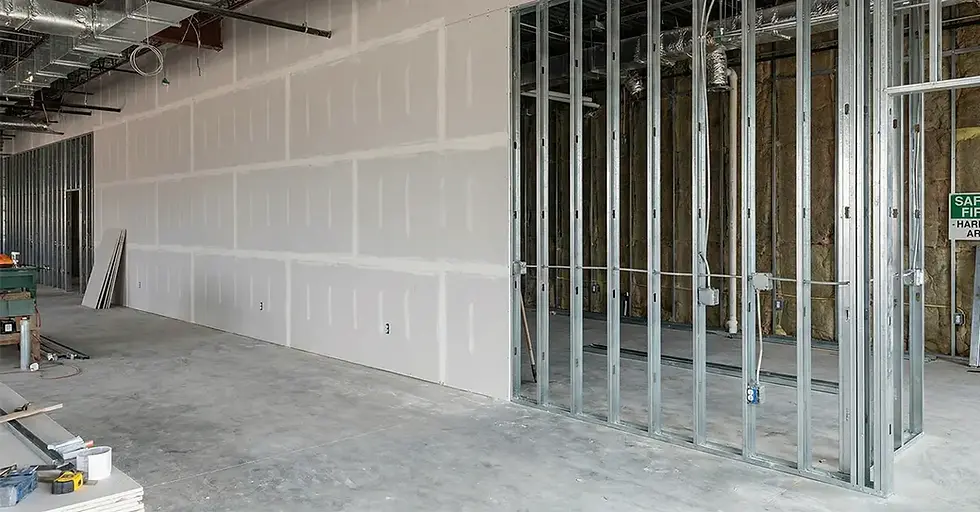
What Is Interior Steel Framing? A Complete Guide to Drywall Framing Systems

Interior steel framing is one of the most widely used construction methods for creating non-load-bearing partition walls, ceilings, and drywall assemblies in modern buildings. Compared to traditional wood framing, galvanized steel framing offers superior dimensional accuracy, durability, moisture resistance, and long-term performance.
Today, interior steel framing systems are used in residential, commercial, healthcare, educational, hospitality, and industrial projects where reliable drywall construction is essential.
This guide explains how interior steel framing works, the components involved, and why galvanized steel has become the preferred framing material for modern drywall systems.
What Is Interior Steel Framing?
Interior steel framing is a non-load-bearing framing system manufactured from cold-formed galvanized steel components.
Rather than supporting the building's structural loads, these framing systems create interior partition walls, suspended ceilings, soffits, shafts, and drywall assemblies.
A complete interior framing system typically includes:
Drywall studs
Drywall tracks
Furring channels
U channels
Long angles
Resilient channels (RC1)
Each component performs a specific function while working together to create stable and durable drywall systems.
How Does Interior Steel Framing Work?
An interior steel framing system begins with drywall tracks installed along the floor and ceiling. Drywall studs are then positioned vertically within the tracks to create the wall framework.
Depending on the project, additional framing members such as furring channels, U channels, long angles, and resilient channels may be installed to support suspended ceilings or improve acoustic performance.
Once the framing is complete, gypsum board is fastened to the steel framework, creating smooth interior wall and ceiling surfaces ready for finishing.
Main Components of an Interior Steel Framing System
Drywall Studs
Drywall studs form the vertical framework of interior partition walls. They provide support for gypsum board while maintaining straight, dimensionally accurate wall assemblies.
Drywall Tracks
Drywall tracks are installed horizontally at the top and bottom of walls, securing drywall studs and maintaining proper alignment throughout the framing system.
Furring Channels
Furring channels create level suspended ceiling systems while providing reliable support for drywall ceiling installations.
U Channels
U channels support suspended ceiling assemblies and help position furring channels correctly during installation.
Long Angles
Long angles reinforce ceiling framing systems by supporting and aligning suspended ceiling components.
Resilient Channels (RC1)
Resilient channels improve acoustic performance by reducing sound transmission between wall and ceiling assemblies through the isolation of drywall from the framing structure.
Explore our interior steel framing guides to learn how drywall studs, tracks, furring channels, resilient channels, U channels, and long angles work together in modern drywall framing systems.
Benefits of Interior Steel Framing
Interior steel framing offers several advantages over traditional wood framing.
Superior Dimensional Accuracy
Steel framing components are manufactured with consistent dimensions, resulting in straighter walls and more precise installations.
Corrosion Resistance
Galvanized steel provides long-term protection against corrosion, helping maintain structural integrity throughout the building's life.
Moisture Resistance
Unlike wood, steel does not absorb moisture, reducing the risk of swelling, warping, or mold-related damage.
Fire Performance
Steel is non-combustible, making it an excellent choice for projects requiring improved fire safety.
Faster Installation
Lightweight framing components allow contractors to complete installations quickly while maintaining consistent quality.
Long-Term Durability
Steel framing retains its shape over time without shrinking, twisting, or cracking.
Where Is Interior Steel Framing Used?
Interior steel framing systems are commonly used in:
Residential buildings
Apartment developments
Office buildings
Hotels
Hospitals
Schools
Retail spaces
Warehouses
Industrial facilities
Institutional buildings
Its versatility makes it suitable for virtually any project requiring interior partition walls or suspended ceiling systems.
Interior Steel Framing vs Wood Framing
Both framing materials are widely used, but steel offers several advantages.
Interior Steel Framing | Wood Framing |
Consistent dimensions | Can warp or shrink |
Moisture resistant | Moisture sensitive |
Non-combustible | Combustible |
Termite resistant | Vulnerable to insects |
Lightweight | Heavier |
Long service life | Requires more maintenance |
The right choice depends on project requirements, but galvanized steel has become the preferred option for many modern drywall applications.
Choosing the Right Interior Framing Components
Selecting the appropriate framing system depends on several factors, including:
Wall height
Drywall thickness
Acoustic requirements
Ceiling configuration
Project specifications
Building code requirements
Using compatible framing components ensures optimal performance and efficient installation.
UMS Metal Interior Steel Framing Systems
UMS Metal manufactures high-quality galvanized interior steel framing products engineered for reliable drywall construction.
Our product portfolio includes:
Drywall Studs
Drywall Tracks
Furring Channels
U Channels
Long Angles
Resilient Channels (RC1)
Manufactured to recognized ASTM standards, UMS Metal framing products deliver dimensional accuracy, corrosion resistance, and dependable performance for residential, commercial, and institutional projects throughout North America.
Conclusion
Interior steel framing has become the industry standard for modern drywall construction thanks to its durability, dimensional accuracy, and efficient installation.
Whether you're building partition walls, suspended ceilings, or complete interior framing systems, galvanized steel components provide reliable performance and long-term value for virtually every type of building project.